


25 years since 9/11, the moment the world changed forever

It was the dawn of a new millennium, the start of a new century, but we were very much still a world of the 1990's. This was a world at the end of empire, with the dissolution of the Soviet Union, and the breakup of Czechoslovakia. This was the world of the Super Nintendo, the Sega Megadrive, the Gameboy, the PC, the laptop, and the start of the World Wide Web, this was the world at the beginning of a technological revolution.
This was the world of superstars. Individuals who were so influential and popular, it is difficult to quantify. In Politics you had Nelson Mandela, released from Prison and later the President of South Africa, and a man who united the people of a country after the end of Apartheid. There was Diana, Princess of Wales, a woman whose celebrity was bigger than any person who had ever lived and was loved by hundreds of millions of people around the world. Her death was sudden, and tragic, and it was met with a national and global outpouring of genuine sadness, shock and grief.
This was the world of sportsmen and women who transcended their sport to a global fanbase of billions at the dawn of the Internet age. Until the emergence of Michael Jordan, Basketball was largely the preserve of the Americans, but Jordan's charisma, talent and achievements with the Chicago Bulls popularized the sport globally. In 1990 there were some 46 countries which took part in the Basketball World Cup, and the 2027 edition will feature 212 countries competing across qualification and the finals.
In the middle of the Michael Jordan era a young man with immense potential and clear talent broke out as a professional golfer, his name was Tiger Woods.
I first picked up a golf club in the summer of 1995, inspired by Nick Faldo's exploits at the 1993 Ryder Cup, and what a time to start playing golf, right at the start of the Tiger Woods era. I was 11 years old.
The excitement of watching Tiger on TV win the Masters in 1997, and in 1999 his second Major title at Medinah in a duel with another young phenom Sergio Garcia, ensured my interest in playing golf became a passion which I have had for more than 30 years. Over the course of the next 2 years Tiger would go on etch his name into golfing history and become undoubtedly the world's most influential sportsperson, and arguably, after my parents, the most influential person in my life. A win by 15 shots in the 2000 US Open at Pebble Beach, a win by 8 shots in the 2000 Open at St Andrews, a win in an epic playoff against Bob May in the 2000 PGA Championship at Valhalla, and a stunning victory at Augusta in the 2001 Masters completed the 'Tiger Slam'.
Tiger was the Michael Jordan of golf, and both were Nike athletes. They were the symbols of sporting excellence, and icons, transcending their sports to a whole new audience around the world. They were peak 1990's and leading the world into the new Millennium. This was the world of hope, excitement and unity. Hope for a more peaceful world, with the fall of empire. Excitement about the technological revolution ahead of us, and a more United and interconnected world than ever before.
This was a great time of discovery and development for me too, getting my first job and working my first shift at Roses the Ironmongers in Devizes, Wiltshire on 1 May 2001, and moving towards my 18th birthday.

Tuesday 11 September was five days before I would turn 18.
I was at the start of my second year of sixth form at Devizes School and one of the 2-3 shifts a week I worked at Roses was on a Tuesday afternoon after school between 3.30pm and 5.30pm. As I left the school and headed towards Roses my mum was waiting for me in the car park. She told me that aeroplanes had hit the twin towers of the World Trade Center in New York.
Despite being 17 and fairly rounded in terms of my education, I must admit that at the time I didn't really have much of a mental picture of what the World Trade Center was, and what this meant, or why my mum had stopped to tell me. In contrast to when she woke me up early on Sunday 30 August 1997, the morning after the night when Diana, Princess of Wales was killed. That resonated with me massively.


Over the next couple of hours at work it was the only thing which people talked about, and whilst I was obviously affected by news of terrorism in the UK including the IRA in the years leading up to 2001, it was not until I got home and saw the picture for myself that I fully grasped the significance of what had happened thousands of miles across the Atlantic. The scenes, as we all know, were absolutely horrific.
2,977 innocent souls were lost on a day which will never be forgotten. The moments of seeing the second plane hit the south tower will live with everyone who witnessed it around the world, and obviously the impact on those people in and around the World Trade Center, Manhattan and around New York will be deeply felt for generations.
My father was a retained Firefighter in Devizes, Wiltshire from 1991 to 2001 and was at home watching on Sky News whilst I was at school until 3.15pm and then work until 5.30pm.
Speaking as someone who has a father who was a firefighter, every time he went on a call there was a chance he may not return, and sadly on 9/11 that would be the case for 343 members of the New York Fire Department.


On the morning of September 11, 2001 Tiger Woods was 975 miles west of New York City, playing a practice round at Bellerive Country Club ahead of the World Golf Championships-American Express Championship. The International Federation of PGA Tours' first step was to postpone the first round of the American Express Championship to Friday because many of the golfers were struggling to get to St Louis. Then on Wednesday, with 18 players still unable to reach St Louis, and with the world in mourning, the Tour decided to cancel the event. For Tiger this would be the first of three events affected for him.
Woods had signed a deal to play in the Trophee Lancôme near Paris, an event which at the time was one of the most prestigious in European golf, backed by Mark McCormack's IMG from 1970 and even held more importance than the French Open at the time. However, following the 9/11 attacks Woods withdrew, saying that he believes it is more important to remember the victims of Tuesday’s deadly terrorist attacks in New York and Washington. “I also fear that the security risks of traveling overseas at the present time are too great,” he said in a statement on his website.
The tournament went ahead without Woods, and was won by Sergio Garcia, but it would only be played twice more in 2002 and 2003, and Woods would never ever play an individual tournament in France throughout his career.
Momentum grew early about the postponement of the Ryder Cup, which was scheduled for 3 weeks after 9/11. Jim Furyk, a key member of the victorious 1999 US team, said: "We're supposed to leave in 13 days. It's an important event. It's the Olympics for us. But there are more important things in life."
Stewart Cink agreed with the sentiments of his American team mates, and said he feared for his own safety. "I feel a lot less safe about flying to England than I did 24 hours ago," he said.
"I have a wife and two boys and do not want to make them live without a husband and without a father just because I want to play in the Ryder Cup.
Cink, who was due to make his Ryder Cup debut this month, said he felt the tournament might well be a target for further terrorist attacks.
He said: "The United States do not have many national sides in international competition, so this would be a huge target for any of America's enemies. If someone wanted to strike at America, or freedom, or capitalism, the Ryder Cup would be a tempting event to hit."
He called for the event to postponed indefinitely. He said: "I don't think the Ryder Cup should go ahead."
The US team were practising in St Louis when they heard news of the tragedy. Tiger Woods was on the back nine of his practice round at Bellerive Country Club when he was informed of the attacks by a retired FBI agent in charge of PGA Tour security.
"Look at this, I've got goosebumps," Woods said as the magnitude of the attacks hit him. "This is a sad, sad day in America."
Ireland's Padraig Harrington, a member of Europe's Ryder Cup team, said: "I would support any action they want taken. There is no doubt this has hit the American players hard."
His Ryder Cup team mate Bernhard Langer watched the news, then played his practice round. "You can't hide your head in the sand and cry all day," he said. "But I felt like it."
Guy Kinnings, manager of seven-times European number one Colin Montgomerie and his Ryder Cup team-mate Thomas Bjorn of Denmark, said players in St Louis for the American Express Championship were in "absolute shock".
He said: "I don't think most players have had the chance to think about it right now. Tournament schedules and so forth aren't exactly uppermost in their minds. I suspect we'll need a few days before we'll be in a position to know what to do [about the Ryder Cup]."
On Sunday 16 September, my 18th birthday, the PGA of America and Ryder Cup Europe announced the postponement of the 2001 Ryder Cup to September 2002. "The scope of last Tuesday's tragedy is so overwhelming that it would be impossible for the United States Ryder Cup Team and officials to attend the matches this month.
"We have been placed in a position beyond our control and therefore the matches, out of necessity, have been postponed."
Despite his disappointment at the delay, European captain Torrance said the right decision had been taken.
"The decision to postpone the Ryder Cup matches this year is one of common sense," he said. "What happened in America last week has put the Ryder Cup and everything else into perspective. There will be time enough to talk further about the 34th Ryder Cup matches taking place next year."
Tiger Woods reacted by saying: "I definitely think it's the right decision, especially with retaliation imminent,"
"The last thing you want to do is get caught in Europe."
"I think we need to come together as a nation, and I think we're doing that.
"It's unfortunate that it took a situation like this to bring people together, but at least it's happening.
"Our national pride is starting to come out."
The attacks on 9/11 impacted Tiger in a more acute way than most other golfers and sports stars, as at the time Woods was the face of American Express. Indeed, one of his most famous advertisements sees him play golf across Manhattan, and the twin towers of the World Trade Center feature prominently.
American Express had to leave its headquarters temporarily because it was located directly opposite the World Trade Center and was damaged during the fall of the towers. Eleven American Express employees lost their lives during the September 11 terrorist attacks. These on-site travel agents worked on the 94th floor of the North Tower of the World Trade Center.
Woods recorded a five-minute message for the employees of American Express following 9/11. Remarkably in the approach to the 25th anniversary of 9/11 the PGA TOUR are again staging an event at Bellerive Country Club near St Louis, Missouri, the same course which was due to host the cancelled WGC-American Express Championship in 2001. The BMW Championship is the penultimate event on the PGA TOUR calendar for the 2026 FedEx Cup, and will feature the leading 50 golfers on the tour this season.
Tiger's travel concerns, and the impact upon travel logistics of all tournament professionals across the world was significant, and the whole world would have to get used to changes in security when travelling internationally.
Changes to security protocols for everyone after 9/11
The Ryder Cup, as we know, was put back to September 2002 and the event was subject to significant increases in security checks for all people attending The Belfry.
Spectators were banned from bringing mobile phones and cameras, Audible pagers, Ladders, Picnic baskets, Briefcases, Portable televisions, Push chairs, Bicycles, Lawn chairs, Bags, rucksacks, backpacks or carryalls larger than 8ins (20cm) sq
Vehicle access to the course was strictly limited and people were searched, using X-ray style machines, at special checkpoints.
A special bus service ferried spectators to the course from designated pick-up points in Birmingham.
Armed Law Enforcement: Officers dressed in black and carrying automatic rifles and machine guns blanketed the grounds.
Crowd Control: Following volatile fan behaviour at the 1999 Ryder Cup at Brookline, organizers instituted a zero-tolerance policy to immediately eject any hecklers.
Surveillance: Closed-circuit television (CCTV) cameras were deployed across the course for the first time
Many of these policies have remained in place for the biggest events in the sport, including baggage checks for spectators, staff and media. Events such as The Open and Senior Open operate a park and ride system, from local points, for example Gleneagles Station for this year's Senior Open.
Airport security changed dramatically in the wake of 9/11 with some of the changes including:
Federal Control: The United States created the Transportation Security Administration (TSA) to run airport screening instead of private companies.
Restricted Access: Only people with a valid ticket and ID can go past the security checkpoint. Friends and family can no longer walk with you to the departure gates unless they have special passes.
Stricter Rules for Items: Sharp objects, large liquids, and gels were banned or limited in carry-on bags
Now, a quarter of a century later the world is far removed from what it was like on September 10, 2001, and so is the world of golf.
The rise of anti-Muslimism and immigrant sentiment was clear from the immediate aftermath of 9/11, and the last 25 years have seen nothing to quell that attitude, in fact the development of social media and the policies and wishes of certain politicians have helped to exacerbate the abuse that Muslims and immigrants face all over the world. Social Media as we know it was invented in 2001 with Windows Messenger, followed by LinkedIn, Myspace and Skype in 2003, Facebook in 2004, Bebo, YouTube and Reddit in 2005, Twitter in 2006, Instagram in 2010, Snapchat, Google+ and Twitch in 2011, TikTok in 2017, and Truth Social in 2022.
Conspiracy-theorists existed in 2001, but they did not have the tool of social media to spread their misinformation, and there is clear evidence of those conspiracy-theorists using social media nearly 25 years after 9/11 to spread lies.

And it is not just the events of 9/11 that conspiracy-theorists use social media to pour scorn and doubt on, the eruption of Mount St Helens in 1980 is on these deprived people's radar.

The video of the Mount St Helens eruption is a timelapse photography sequence shot by a photographer Gary Rosenquist, and the people on social media saying it is AI are either ignorant or wilfully deceiving people. Nearly 20 years after 9/11 another major tragedy struck America and the World - the Covid19 Pandemic. By now social media had reached almost every corner of the earth, with 3.8 billion users worldwide, and it became the cess-pit of lies and misinformation about the Pandemic. It became a place where people who were keeping us safe and trying to protect us from this potentially deadly virus (killed more than 7 million worldwide to date), were getting abused for doing so.
Hospitals were full and at breaking point, yet users on social media continued to use their platforms and profiles to put doubt on this.
As well as spreading misinformation and lies, social media has, unfortunately become a tool to legitimize racism, diminish racist attitudes and spread racist hate. After the election of Zohran Mamdani as New York City Mayor, there was another uptick in the use of social media to spread racist hate, and harking back to the origins of the Hijackers of the planes on 9/11.


Social Media platforms have made reporting such acts harder than ever before, and if a certain post and its content does not fit exactly with one of the items on a dropdown list then it is not removed, despite it clearly being racist or having racist undertones. Nearly a quarter of a century on from 9/11, a time when we were united, we are now possibly more divided than at any time in history. Not country v country, but people v people within every country in the western world.
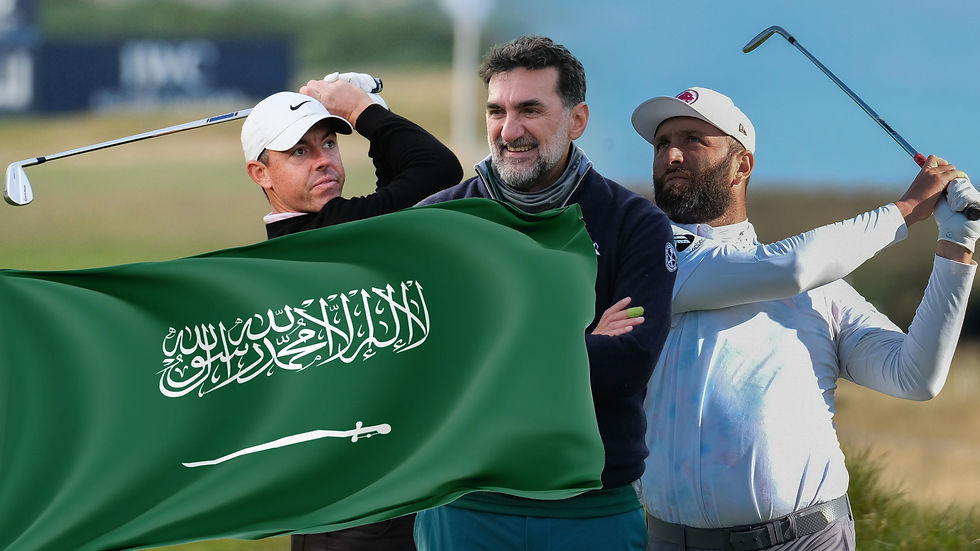
A perfect example of how the world has changed in this way is the golfing community's reaction to the emergence of LIV Golf. The league was backed by the Public Investment Fund of Saudi Arabia, which caused offense and outrage across the USA, and the PGA TOUR Commissioner Jay Monahan even used 9/11 as a reference to criticise the players which joined the league when it was established in June 2022.
LIV Golf, it was argued, divided the sport, but in reality the sport has never been united, and in my opinion it actually crystalised the current situation humanity is in. We are in a world now where EVERYTHING is Marmite. You either LOVE something, or you HATE it. We are a divided people, and extremes of opinion take over. Those who hated LIV Golf refused to even see any good aspect to it, despite the wildly successful events staged in Australia and South Africa. Those who loved LIV Golf refused to accept the negative aspects of it, and refused to accept the reality that it was never going to succeed in the existing golf ecosystem. Nuance has been completely lost in society, and the ability to hold a nuanced view on anything, especially on LIV Golf.
LIV Golf has also emphasised how money has transformed golf and sport at the highest level, with $20-30million prize funds offered by the Saudi-backed league, and the marginalisation of history, tradition and the etiquette of the game.

In the 25 years since 2001 professional golf, much like society, has become entrenched in taking a certain position, and become more introverted. Men's professional golf was confidently going global in 2001, two years on from the first WGC, five years after the creation of the International Federation of PGA Tours and six years after the first co-sanctioned tournaments between major tours. There seemed to be a genuine spirit of collaboration between the rival tours, and the world's best golfers were seemingly more able to play a global schedule free of the restrictions and demands which the PGA TOUR in particular, places on them today.
The 2001 PGA TOUR season ran from the second week of January to the first week of November, with members required to play 15 tournaments to keep their card, and the European Tour schedule ran predominantly from January to November with members required to play 11 events to keep their card. In 2001 The 4 Majors and 3 World Golf Championships counted for both tours, meaning a top golfer who wanted to be a member of both the PGA TOUR and European Tour could do so by playing as few as 19 tournaments across a 44-week period.
So, structurally the tours made it easier for a top player to play a more global schedule, which is born out by Tiger Woods, even if he never became a European Tour member. In the 2001 season Tiger entered the Johnnie Walker Classic, Dubai Desert Classic, Deutsche Bank SAP Open - TPC of Europe, and Trophee Lancôme, alongside the Masters, US Open, The Open, PGA Championship, WGC-NEC Invitational, and WGC-American Express Championship.
He didn't play in the WGC-Accenture Match Play in Australia because it was ludicrously scheduled for the first week in January, and he was one of many withdrawals from players ranked inside the world's top 64. The WGC-American Express Championship was cancelled, and he withdrew from the Trophee Lancôme, both due to 9/11. With better scheduling of the Accenture Match Play, and without the tragedy of 9/11 Woods would have comfortably fulfilled the membership criteria of the European Tour, and won the Harry Vardon Trophy.

Tiger received appearance fees to play in the tournaments in Thailand, Dubai, Germany and France, but he always demonstrated a willingness to play around the world, throughout his career, and he was successful doing so. During his peak years of 1996 to 2009 Woods played the following tournaments around the world: Wins in Bold
1996 Holden Australian Open 2002 Deutsche Bank SAP Open TPC of Europe
1997 Ericsson Australian Masters 2002 THE OPEN
1997 THE OPEN 2002 WGC-American Express Championship
1997 Honda Asian Classic 2002 Dunlop Phoenix Tournament
1998 Johnnie Walker Classic 2003 Deutsche Bank SAP Open TPC of Europe
1998 THE OPEN 2003 THE OPEN
1998 Alfred Dunhill Cup 2004 Dubai Desert Classic
1998 Toyota World Match Play 2004 THE OPEN
1998 Nedbank Million Dollar Challenge 2004 WGC-American Express Championship
1999 Deutsche Bank SAP Open TPC of Europe 2004 Dunlop Phoenix Tournament
1999 THE OPEN 2005 THE OPEN
1999 WGC-American Express Championship 2005 HSBC Champions
1999 Johnnie Walker Classic 2005 Dunlop Phoenix Tournament
1999 World Cup of Golf 2006 Dubai Desert Classic
2000 Deutsche Bank SAP Open TPC of Europe 2006 THE OPEN
2000 THE OPEN 2006 HSBC World Match Play
2000 Bell Canadian Open 2006 WGC-American Express Championship
2000 WGC-American Express Championship 2006 HSBC Champions
2000 (2001) Johnnie Walker Classic 2006 Dunlop Phoenix Tournament
2000 WGC-EMC2 World Cup 2007 Dubai Desert Classic
2001 Dubai Desert Classic 2007 THE OPEN
2001 Deutsche Bank SAP Open TPC of Europe 2008 Dubai Desert Classic
2001 THE OPEN 2009 THE OPEN
2001 Trophee Lancôme WD DUE TO 9/11 2009 WGC-HSBC Champions
2001 WGC-EMC2 World Cup 2009 JBWere Australian Masters
2002 Telstra New Zealand Open
Now, 25 years on we have a very different landscape of men's professional golf, and a very different generation of golfers who focus mainly on playing in the USA on the PGA TOUR.
Scottie Scheffler's peak seasons of 2022 to 2026 have seen him playing significantly less tournaments outside of the USA than Tiger Woods during his peak years:
2022 RBC Canadian Open 2024 Olympic Games
2022 Genesis Scottish Open 2025 Genesis Scottish Open
2022 THE OPEN 2025 THE OPEN
2023 Genesis Scottish Open 2026 Genesis Scottish Open
2023 THE OPEN 2026 THE OPEN
2024 THE OPEN
So Scheffler has played 11 tournaments in the last 5 years which have taken place outside the United States of America, five of them have been The Open Championship, one was the Olympic Games and one was north of the border in Canada. Scottie Scheffler last played a tournament sanctioned by the major tours outside Europe and North America in 2019 when he was on the Korn Ferry Tour, and he played in Colombia. Even if we narrow down Tiger's peak years to be 1996 to 2001, Tiger played double the number of international events that Scheffler has played since 2022. Tiger played events on the European Tour, the Asian Tour, the Sunshine Tour, the PGA Tour of Australasia and the Japan Golf Tour. Tiger played six times in Germany alone, it is almost certain Scottie Scheffler will never play a single tournament in Germany in his career.
Yes, Tiger was paid upwards of $3million to play in some of these tournaments, but what is so impressive is his record in those events which he could easily have been on easy street and not competed for the title. Tiger won 19 tournaments outside the United States and the only continent he didn't win on was Africa, where he was denied victory in the 1998 Nedbank Million Dollar Challenge by Nick Price at Sun City in South Africa. I have already discussed the the technical aspects of how the schedules of men's professional golf have changed since 2001, but also, it cannot be avoided, the money they are playing for is vastly more in 2026 than it was in 2001. Scottie Scheffler can play an almost exclusively American schedule and make more than $100million on the course over the last five years alone, in Tiger's peak years of 1996-2001 he made $25million on-course in PGA TOUR earnings, some four times less than Scheffler.
Player's attitudes are now different too. Tiger cared about his legacy, and his brand, and he used playing around the world to build the greatest golfer driven brand we have ever seen, following in the footsteps of Arnold Palmer and Jack Nicklaus. Whereas, Scottie has openly said he doesn't think or care about his legacy.
This attitude is reflective of the society we have now come to live in, 25 years on from 9/11.
Many in the world are now self-centred individuals, we are in it for ourselves and a sense of our contribution to the wider society has been eroded. This was the attitude on both sides of the debate around LIV Golf.
The established tours were all thinking about their own identity and own desires for the sport when they attacked LIV Golf, rejected the PIF Investment and set about banning and smearing the golfers who joined. Comparatively the golfers who joined did so for their own reasons, thinking about what was best for themselves, not what was best for golf more generally.
Golfers of the past were also far more conscious of the importance of the media in the role of growing this great game and introducing new people to it. The social media explosion happened four to five years after 9/11 in the mid-2000's and now in 2026 some of the world's most prominent golfers have gigantic social media followers which they value more than speaking to the traditional media. The images and video we see from 9/11 were captured with professional cameras or disposable cameras, camcorders or the cameras of the world's media, if the attacks happened now the vast majority of the footage would come from people's smart phones, and shared on Facebook, Instagram, X, TikTok, Snapchat, YouTube and other platforms which did not exist 25 years ago.
Now as we come to the 25th anniversary of 9/11 it is time to reflect on where we are and what the world looks like in comparison to back then on that Sunny Tuesday.
I, we, you started that day in 2001 with hope and excitement for the future. The world was more united than at any stage in decades, and we were a tolerant society with a global outlook. Now, we are a world which is intolerant, and in many ways racist which is railing against multi-culturalism, and we are all individuals with a lack of awareness of or care for our community. On the golf course, men's golf now is nowhere near being united on a global vision for the sport, with the top level of this game set to become more US-centric than any time in recent history. The tours, the media and the golfers themselves are in it for themselves, with a lack of respect and regard for the wider golfing ecosystem, and that has been on a slippery slope for 20 years since the introduction of the FedEx Cup, not just since LIV Golf came onto the scene.
25 years since 9/11 we are a worse people, it is a worse world, and we must do better. Those who perished, and those who gave their lives trying to save others would expect better of us, and we must deliver. 9/11 saw the loss of people from 103 countries, the world was united in grief, and for the most part the response was a world united against evil. There are great people from all over the world, and there are great places all over the world, and that is what makes discrimination, racism and hate towards immigrants so absolutely daft, and it is a big world out there, which the best golfers in the world should be discovering. 9/11 shows that our lives are precious, and our time on this planet is limited and can end at any moment without warning, so the time has come for the squabbling to stop, let's bring this sport together and honour the lives lost on 9/11 and foster a greater sense of camaraderie, collaboration and have a more open outlook.
SHANK, by Matt Hooper
Matt Hooper is an Associate Member of the Sports Journalists Association
This feature was written to honour the lives of the people lost on Tuesday September 11, 2001 and showcase how I believe the world, and the world of golf has changed from that day forwards to September 2026. I used a wide range of sources to research the day, aside from my personal memories and experiences, and to research the human reaction and how the world has changed. Sources are listed below.
This piece also includes elements which are my opinion based on a lived experience.
No element of this feature is meant to offend or disrespect the memory of the people lost on 9/11, and the article is intended to demonstrate the changes in the world, and the world of golf since that terrible day.
Sources:
YouTube
9/11 through New Yorker's eyes - Raw stories from Ground Zero https://youtu.be/0xpoqnR8-CI?si=Q1wjozANyDVFDHaP
PBS News Hour https://youtu.be/jEVW3pFXSDM?si=6dd5q62t24x_6XxM
Eye witness video of 9/11 https://youtu.be/c7mf4W8kL4s?si=CBUJC-SqNHGtt6y8
September 12, Ground Zero https://youtu.be/aV0NeXCgGLY?si=Pt5-B_HRzduDrMzD
CNN Live Sept 11, 2001 https://youtu.be/Bi5qbHbqMeA?si=H9IK-StO6QvwMToD
CBS2 NY local Live coverage September 11 https://youtu.be/VsVyODADkWk?si=bszGz1pU0G_O6jr7
ABC World News Tonight September 11 https://youtu.be/Ykx81tQLnBQ?si=YIxGt4FPnwHmp_ls
Night Before 9/11, NYC newscast September 10 https://youtu.be/x88_b6vxI_Y?si=vwc8j3ao3NP0FGCq
NBC Nightly News September 11 https://youtu.be/aFLEFj2KKdU?si=5-gzlGURd86PeYIV
Live Regis and Kelly 9/11/01 https://youtu.be/_h1wDjMwkOA?si=M-YeG-FuIbE7e_Yt
9/10 The Final Hours (National Geographic documentary https://youtu.be/L0UGVkvf1VY?si=DYEt02svbO6MOMgL
HBO Original Documentary
In the Shadow of the Towers, Stuyvesant High on 9/11 In the Shadow of the Towers: Stuyvesant High on 9/11 • HBO Max
National Geographic documentary series
One day in America on Disney+ 9/11: One Day in America (TV Mini Series 2021) - IMDb
Wikipedia, various pages
OWGR.com
Tiger Woods pulls out of Lancome trophy Woods Pulls Out of Paris Event - Los Angeles Times
Woods backs Ryder Cup decision BBC SPORT | GOLF | Woods backs Ryder Cup decision

Comments